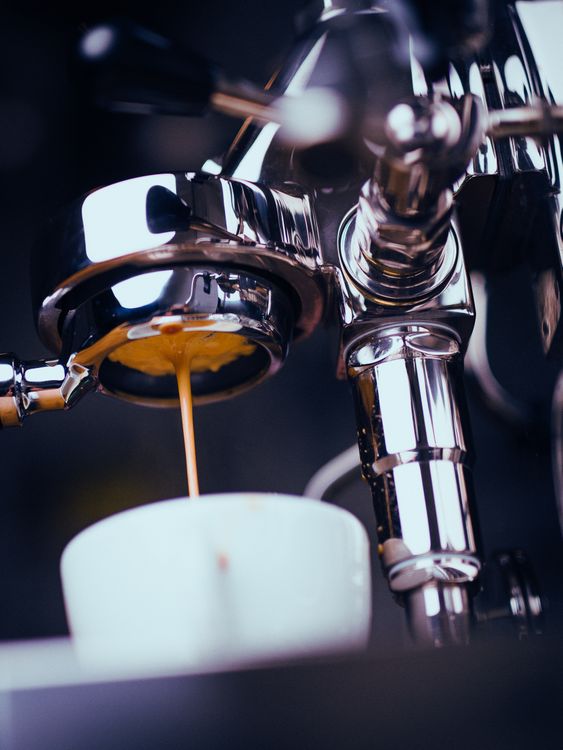
Walk into a third-wave café in 2015 and the menu would list the espresso as "today's single origin: Kenya Nyeri, washed process, tasting notes of blackcurrant and lime." Walk into the same café in 2026 and the espresso is back to being a blend. Not because the standards dropped — because the industry learned something.
Espresso is a fundamentally different extraction problem from pour-over. Nine bars of pressure through finely ground coffee in 25-30 seconds is a narrow, aggressive process. It rewards coffees that can survive that aggression, and it amplifies every flaw in the bean alongside every virtue. A single origin that tastes incredible at 94°C water and a two-minute draw-down can taste loud, unbalanced, or simply tired as a shot. The fix is blending, and the fix is not a compromise.
/ 01What espresso actually asks for
A great shot needs four things to happen at once:
- Body and crema — the drink has to feel substantial in two ounces
- Balance — sweet, acid, bitter, body in roughly equal proportions, not any one dominant
- Sweetness as the primary note — the shot should taste sweet first, everything else second
- Stability under milk — for cafés serving cappuccinos, the shot has to still be recognizable under four ounces of foam
No single origin, even a great one, reliably delivers all four. A washed Ethiopian gives you the acid and sweet but not the body or the milk-stability. A pulped-natural Brazilian gives you the body and sweetness but often lacks the acid and finish. A high-altitude Colombian does three of the four but usually lacks the crema volume of a lower-grown coffee. The compromises are not fatal, but they are visible to anyone who drinks the shot.
/ 02The triple-origin formula
Most great espresso blends follow a similar pattern. Not because anyone is copying anyone else, but because the mathematics of the extraction converge on the same shape. The formula tends to be:
The HexRoast espresso blend (#D4A574, "Crema") follows this structure almost exactly: 55% washed Colombian, 25% washed Ethiopian, 20% natural Ethiopian. Different roasters will swing the ratios and swap the components, but the architecture is the same.
/ 03Why three and not two
A two-origin blend works. Many classic Italian espresso blends are two-origin. But three consistently outperforms two for a specific reason: the third component lets you separate "body" from "depth."
In a two-origin blend, the South American is doing double duty — providing both the body and the sweet chocolate finish. You cannot turn up one without turning up the other. If you want more finish, you get more weight; if you want less weight, you lose the finish.
With a third component, specifically a small amount of natural process or darker-roasted coffee, the body and the finish become independent knobs. You can have a shot with moderate body and a strong chocolate finish. You can have a shot with a big body and a subtle finish. The recipe space opens up dramatically.
This is why roasters who care about espresso tend to converge on triple-origin: you get a blend that can be tuned rather than compromised.
/ 04The single-origin counterargument
The case for single-origin espresso is real, and worth stating fairly. A great single-origin shot at a serious bar — pulled by a barista who knows that specific coffee intimately, ground fresh, with a basket chosen for that lot — is a specific experience. It has a clarity that no blend can match, because a blend by definition smooths out the individuating character of any one origin.
If you want the shot to taste like this particular farm, this particular harvest, you want single origin. The experience is analogous to single-barrel bourbon or small-lot wine: the point is the terroir showing through.
But this is a connoisseur experience, not an everyday one. At home, with a domestic espresso machine and a grinder that is probably a bit underpowered for fresh light-roast single origins, the triple-origin blend wins on almost every day of the week. The blend is designed to be forgiving. The single origin is designed to be specific.
/ 05What to look for when buying
- Roast date within the last 14 days. Espresso blends benefit from 7-14 days of rest after roasting (more than pour-over coffees, which peak at 4-7 days). Avoid anything 4+ weeks off-roast.
- The bag should tell you what is in it. "Colombian + Ethiopian + natural Ethiopian, 55/25/20" is a roaster who knows what they built. "Our classic espresso blend" with no component detail is a roaster hiding something or skimping on source.
- A roast level between medium and medium-dark. Very dark roasts lose too much origin character; very light roasts will feel "thin" as espresso. The sweet spot is described on most bags as "second crack starts, second crack extends, pull before rolling second crack."
- Price per pound that makes sense. A good specialty espresso blend runs $18-$28 per pound in 2026. Less than $15 and you are buying commodity. More than $30 and you are probably paying for packaging.
/ 05Tasting a blend without a lab
You do not need professional cupping equipment to learn what a blend is doing. Brew it the same way twice, once on its own and once with milk, and write down what changes. A blend that tastes balanced black may disappear in milk, while a blend that tastes heavy black may open up with it. That difference is not a flaw. It is information about what the blend was designed for, and it is more useful than any single tasting note on a bag.
Also pay attention to how the cup changes as it cools. A well-built blend usually holds together from hot to warm, with acidity softening and sweetness becoming easier to notice. A blend that only tastes good in the first minute is telling you something about its balance. Taste slowly, let the cup cool, and judge the whole arc rather than the first sip.
More coffee writing in this section — no signup, no preorder, just the journal.
More in Brew →