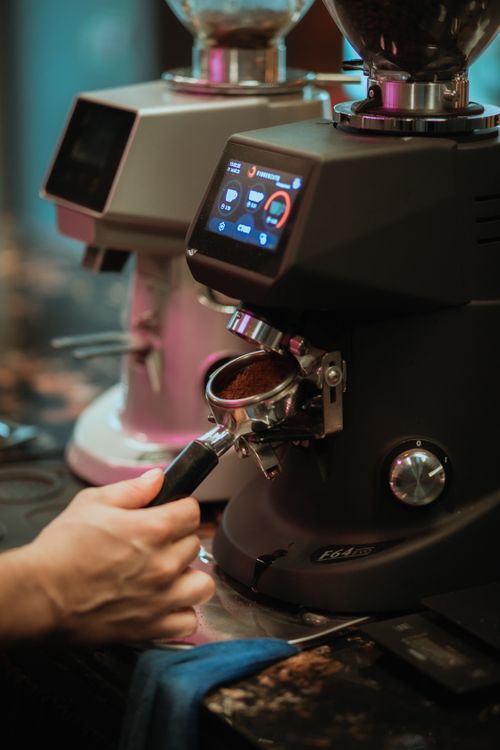
The Mahlkönig EK Omnia is the grinder the EK43 has been threatening to become for years, and this week it finally showed up in the United States. Mahlkönig launched it in the US on November 2, 2026, debuting it at Dallas Coffee Fest, and the manufacturer’s US store now lists it at $4,399. That date matters, because the Omnia is not a new grinder. It was released in Europe in 2024, won the iF Design Award that year, and has spent two years building a reputation overseas while North American cafés waited. The news is not that it exists. The news is that it is here, with a price, a spec sheet, and stock lists — and that the most famous grinder in specialty coffee now has a successor you can actually buy.
/ 01The burrs stayed. That is the point.
Everything about the EK43’s reputation comes down to one component: a pair of 98mm cast steel flat burrs, made in Germany, that grind with a uniformity other grinders measure themselves against. The Omnia keeps those exact burrs. Mahlkönig says so plainly on its own product page, and every retailer repeats it, because it is the sentence that sells the machine. Burr life is rated at roughly 6,000 kg at a median setting, and the grinder moves 11.5 to 13.5 grams per second, which is fast enough that a morning rush never waits on the grinder.
Keeping the burrs is a decision, not a shortcut. It means the Omnia does not ask cafés to relearn what their coffee tastes like. A shop that dialled in a roast on an EK43 will recognise the cup the Omnia produces, because the part that touches the coffee has not changed. What changed is everything around it: a brushless DC motor in place of the EK43’s 1,300-watt workhorse, a touchscreen instead of a dial, and a sensor that measures the actual distance between the burrs in microns instead of asking the barista to trust a numbered dial. The Omnia draws 750 watts and weighs 24 kg, against the EK43’s roughly 30 kg — still a heavy machine, still a countertop commitment, but a lighter and quieter-running one.
That distinction is worth holding onto, because grinder marketing loves to blur it. The burrs decide the particle distribution. The motor, the interface, and the measurement decide how repeatable that distribution is from one shot to the next, and how much of the barista’s attention it costs. The Omnia’s argument is that the EK43’s grind quality was never the problem. The workflow around it was.
/ 02Three modes, one of which is the whole story
The Omnia offers three grinding modes, and two of them are familiar. Classic Mode is the EK43 as everyone knows it: turn the dial to a number and grind. Time Mode adds timed dosing for espresso, so the grinder stops itself after a set interval. Neither of these would justify a new machine.
Library Mode is the reason this grinder exists. It saves up to 10 grind recipes, each with a bean name and a target dose in grams, and when you recall one, the grinder adjusts the burr distance and the volumetric dosing itself. You dial in a coffee once, save it, and the next time that bag goes in the hopper, the machine returns to the setting you saved instead of asking you to find it again by feel.
For a café, that is a real workflow change, and it is easy to see why. A shop that runs three or four single origins across a week, plus a house espresso, spends a measurable part of every morning re-dialling grinders after a bean change. The Omnia turns that into a recall. For a home barista with one bag open at a time, it is less transformative and more of a convenience — a saved setting is nice, but you were only ever one dial turn away anyway.
The honest caveat is that a saved recipe is only as good as the coffee it was saved for. Beans age, humidity shifts, and a roast that tasted one way on Monday tastes different on Friday. Library Mode remembers a number, not a cup. It removes the mechanical work of returning to a setting; it does not remove the tasting work of deciding whether that setting is still right. Anybody who buys this grinder expecting it to dial in coffee for them will be disappointed in exactly the way a person who buys a metronome expecting it to teach them rhythm would be.
/ 03The Mahlkönig EK Omnia, counted honestly
The numbers, as listed by Mahlkönig USA: 98mm cast steel burrs, 1,500 rpm idle speed, roughly 6,000 kg burr life, 11.5–13.5 g/s grinding capacity, a 250 g bean hopper, 750 W maximum power, dimensions of 21.4 × 66.3 × 39 cm, and a net weight of 24 kg. The hopper is the detail that gives away the intended user. Two hundred and fifty grams is a café’s single-dose workflow, not a bulk hopper for a shop grinding a kilo at a time. This is a grinder built for places that weigh every dose, which is to say specialty cafés and the kind of home setup that already owns a scale.
The price is $4,399 at Mahlkönig USA, with at least one US retailer listing it at $4,199. The EK43, by comparison, starts from $3,899 at the same retailer. So the Omnia costs about $300 to $500 more than the grinder it succeeds, which is a small premium for a machine that adds a motor, a screen, and a memory — and a large amount of money in absolute terms. Both statements are true at the same time, and that tension is the whole buying decision. Four thousand dollars is not a grinder purchase. It is a piece of commercial equipment that happens to sit in a kitchen, and it should be judged the way a café judges equipment: by whether it earns its place on the counter every day, not by whether it is exciting on arrival.
That is also why the comparison that matters is not Omnia versus EK43, but Omnia versus doing nothing. An EK43 that already works does not stop working because its successor launched. Its burrs are the same burrs. The upgrade buys workflow — timed dosing, saved recipes, micron measurement — not a better-tasting cup on day one. A café that switches beans constantly, runs filter and espresso from one grinder, and loses time to re-dialling will feel the difference in the first week. A home brewer with one bag open and a dial they already know will mostly feel the difference in their bank balance.
/ 04Who should skip it
The people who should not buy this grinder are easier to list than the people who should. If your grinder budget is $100 or $200 — the tiers where a hand grinder or an entry-level electric grinder lives — the Omnia is not a stretch goal, it is a different hobby. If you brew one method, one coffee, and one dose every morning, Classic Mode is a $4,399 dial. If you are buying your first serious grinder, the money goes further on beans, a scale, and a grinder you can actually learn on without worrying about scratching it.
The people it is for are narrower and, for that reason, easier to serve honestly. A small café that wants one grinder to cover espresso and filter, and wants its recipes to survive a shift change. A roaster’s tasting room that cycles through origins weekly. A home barista who already owns the rest of the setup — machine, scale, water sorted — and whose current grinder is the bottleneck they can name precisely, not vaguely. That last test is the useful one. If you cannot say, in one sentence, what your current grinder fails to do that the Omnia would do, the Omnia is not solving your problem. It is solving a problem you do not have, at a price that assumes you do.
/ 05What to watch next
The launch is the easy part. The interesting question is whether Library Mode survives contact with a real café — whether saved recipes stay accurate across a bag’s life, whether the touchscreen stays responsive with wet hands and coffee dust, and whether baristas who learned on the EK43’s dial actually trust a number on a screen more than a number on a dial. The other question is the EK43 itself. A successor this close in price, with the same burrs, usually pushes the older machine’s secondhand price down, which is good news for the home brewers who never needed the Omnia in the first place.
The EK43 earned its reputation slowly, in cafés, one shot at a time, and the Omnia will have to do the same. A launch price and an awards shelf are not a reputation. They are a promise, and the grinder now has to keep it, every morning, in rooms full of people waiting for coffee. The burrs, at least, are already proven. Everything else is a bet that remembering is worth paying for.
---
HexRoast is a coffee journal. No product is for sale and no preorder is open. Prices above are reference prices as listed on November 6, 2026, and change — re-check before repeating them. Contact: hello@hexroast.com.
Questions about this article: hello@hexroast.com — the one contact address for this site. HexRoast is currently a coffee journal; no product is for sale and no preorder is open.
/ 06Sources
- Perfect Daily Grind, “Coffee News Recap, 6 Nov: Icafe predicts 9.7 million-bag global surplus in 2026/27, Luckin edges closer to Starbucks’ global store count & other stories,” published November 6, 2026 — https://perfectdailygrind.com/2026/11/coffee-news-recap-6-november-2026/
- Mahlkönig USA, “EK Omnia Allround Coffee Grinder” product page — https://www.mahlkoenig.us/products/ek-omnia
- Pro Coffee Gear, “Mahlkonig EK Omnia Grinder” — https://procoffeegear.com/products/ek-omnia
- Homegrounds, “6 Mahlkonig Coffee Grinders: Best Picks and Reviews for 2026” — https://www.homegrounds.co/mahlkonig-coffee-grinders/
- Social check, November 6, 2026: Threads posts dated November 1–3, 2026 showing Omnia units in cafés and dealer inventory (a Bandung café running EK43 and Omnia side by side; dealer promo lists with Omnia V1/V2 pricing in Indonesian rupiah), plus a Facebook video the same day of an EK43 unboxing. The social signal confirms the grinder is actively discussed and stocked this week; the launch peg itself is the Perfect Daily Grind recap and Mahlkönig USA listing, not social buzz.
- Prices note: prices and specifications are reference prices as listed by the sources above on November 6, 2026, and change — re-check before repeating them. No affiliate links, no purchase links, and no brand-launch claims are included in this article.
More coffee writing in this section — no signup, no preorder, just the journal.
More in Brew →