Vietnamese coffee spent decades as the drink you had to go looking for. You found it in a Vietnamese restaurant at the end of a meal, or in a friend’s kitchen, poured from a small metal filter you had never seen before. This autumn it stopped being a secret. “Vietnamese coffees” drew about 165,000 monthly searches as of October 2026, up roughly 30% year over year, according to Rising Trends’ November 2026 coffee-trends list — one of the largest origin-led search volumes in coffee right now. On October 20, the Filipino chain Don Macchiatos launched four Vietnamese-inspired drinks — salt coffee, coconut coffee, iced milk coffee and iced black coffee — brewed through traditional phin filters with Trung Nguyen robusta. And across Instagram and Facebook this week, the feed is full of phin brewing: a Chicago café, VietFive Coffee, posted on November 10 that it still brews about 90% of its coffee through the phin even though it owns an espresso machine; a Harrisonburg boba shop, Boba Cowboy, added Vietnamese coffee to its menu on November 12; home brewers are filming batch phin brews for picnics and salted-maple riffs on the classic iced version.
That is a lot of attention for a drink made with a $10 piece of stamped metal. The attention is the point. Vietnamese coffee is not winning because it is new — the method is older than most specialty cafés — but because it is the opposite of where the rest of coffee has been heading. While the home-brewing conversation this year has been dominated by machines that grind, weigh, tamp and froth for you, the phin asks you to wait five minutes and watch water drip. People seem ready for that trade.
/ 01The bean that makes it work: robusta, unapologetically
Start with the bean, because everything else in Vietnamese coffee follows from it. Vietnam is the world’s second-largest coffee producer, and the USDA forecasts 32.5 million 60-kilogram bags for the 2026/27 crop year — 31.4 million of them robusta, about 97% of national production. The arabica that dominates specialty cafés is a small highland crop there. Robusta is the default, not the compromise.
Robusta has a reputation problem in specialty circles, and most of it is earned: badly grown, badly processed robusta tastes rubbery and harsh. But robusta also has properties no arabica can copy. It carries nearly twice the caffeine of arabica, it produces a thick, heavy body, and its flavour leans dark — bittersweet chocolate, toasted grain, a bitterness that holds its shape instead of dissolving. That aggression is structural. Vietnamese coffee is almost always served with sweetened condensed milk, and a delicate, floral arabica would disappear under that sweetness. Robusta fights back through it. The drink is built as a system — strong bean, slow extraction, heavy sweetener — and if you swap out any one part, the rest stops making sense.
This is also why the recent robusta conversation matters here. HexRoast covered the climate argument last week: robusta is often sold as the climate-resilient future of coffee, and the reality is more complicated than the pitch. What is not complicated is the flavour argument. A well-grown, dark-roasted robusta brewed through a phin is a legitimate, distinct coffee experience, not a budget substitute for arabica. The current surge is partly people discovering that for the first time, and partly people who grew up with it finally seeing their everyday coffee treated as worth writing about.
/ 02The phin: a brewer that refuses to hurry
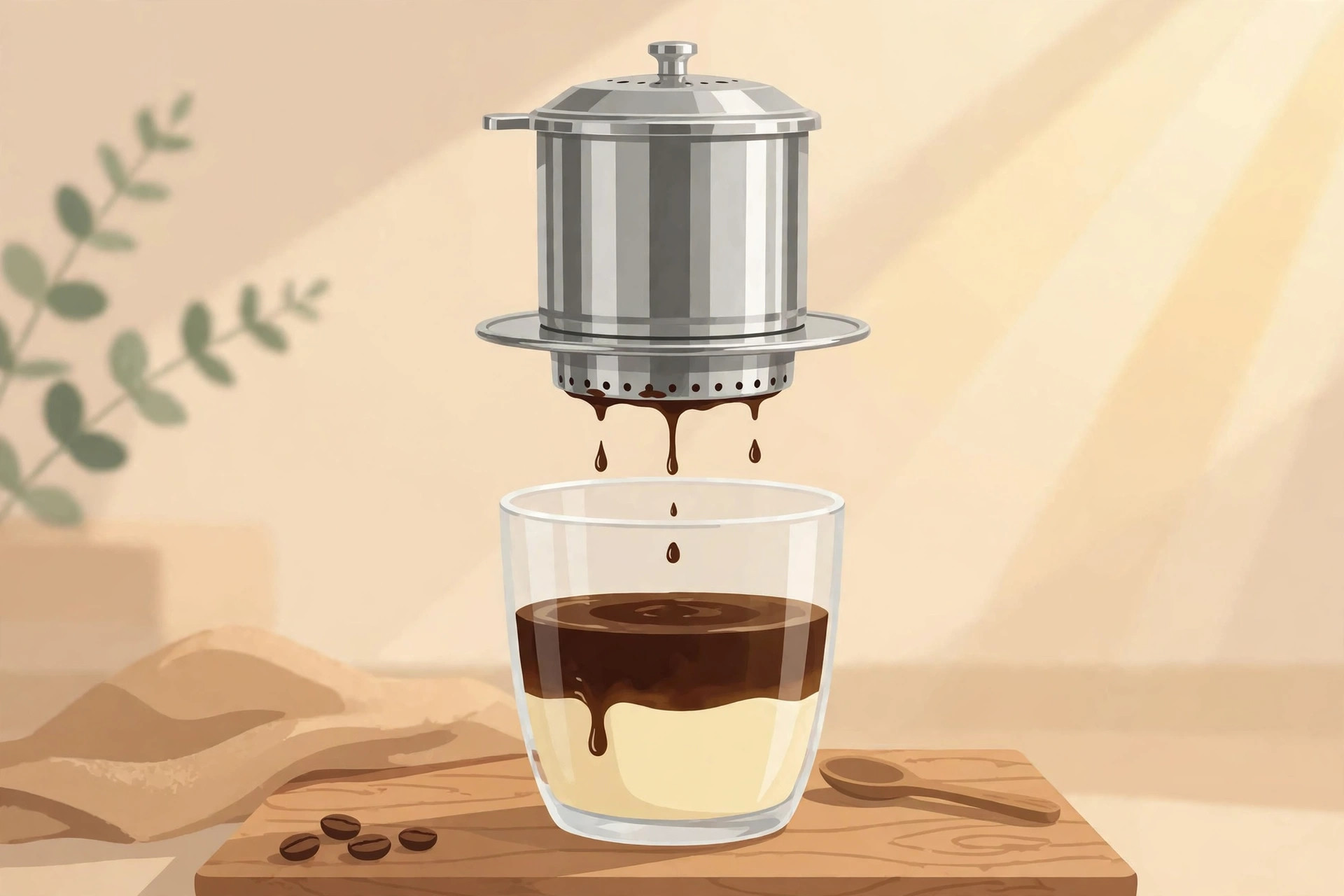
The phin is a small stainless steel chamber with a perforated base, a press plate that sits on the grounds, and a lid. It sits directly on the glass. You add ground coffee, pour hot water over it, and wait while it drips through, one drop at a time, over four to six minutes. There is no pump, no paper filter, no valve, no app. The brewer costs less than a bag of good beans, it fits in a desk drawer, and it has no parts that can break in a way that matters.
The closest comparison is a pour-over, and a Vietnamese roastery, Tourane, posted a side-by-side this week that makes the difference plain: a V60 brews at a 1:15 coffee-to-water ratio in about three minutes and comes out bright and light; a phin brews at roughly 1:5 in about five minutes and comes out concentrated and bold. Same beans, different drink. The phin is closer to espresso in strength and closer to a pour-over in method, and it belongs to neither camp.
The technique is simple, but it rewards a little precision. The recipe the Saigon roaster AV Coffee published on November 12 is a good baseline: 20–25 grams of medium-ground coffee, water at 90–95°C, preheat the phin and the glass, tamp very lightly, bloom with about 20 ml of water for 30–45 seconds, then pour another 50–60 ml, cover, and let it drip for four to six minutes. The drip time is your diagnostic. Under three minutes and the grind is too coarse or the tamp too light; over eight minutes and the grind is too fine or the tamp too firm. Keep the water below 96°C for additive-free roasts, or the bitterness turns harsh instead of deep. None of this is difficult. All of it is the kind of small, repeatable craft that makes a morning ritual feel like yours rather than a button you pressed.
That is the part the automation trend cannot copy. A super-automatic can dose by weight and froth milk to the degree, and those are real conveniences — HexRoast wrote about exactly that yesterday. But no machine can give you the five minutes of watching coffee drip while the condensed milk waits at the bottom of the glass. The phin is slow on purpose, and in a year when every brewer promises to be faster, slowness has become the feature.
/ 03Cà phê sữa đá: condensed milk was always the cheat code
The drink most people mean when they say “Vietnamese coffee” is cà phê sữa đá: strong phin coffee dripped onto sweetened condensed milk, stirred hard, poured over ice. The formula predates the trend by decades — it was being poured on Saigon pavements long before anyone filmed it — and the condensed milk is doing three jobs at once. It sweetens, it adds body, and it keeps for months without refrigeration, which is exactly why it became the default coffee whitener in Vietnam when fresh dairy was scarce. The sweetness is not a garnish. It is load-bearing.
To brew it at home you need four things: a phin, dark-roasted robusta, condensed milk, and ice. In the US, the two beans people reach for are Cafe du Monde — the New Orleans chicory blend in the yellow tin that is a fixture in Vietnamese-American households — and Trung Nguyen, Vietnam’s own coffee brand. Either works; the point is a dark roast with enough body to stand up to the milk. Use about two tablespoons of condensed milk in the glass first, brew the phin directly over it, stir until the mixture is uniform, and pour over a full glass of ice. If the result tastes thin, the problem is almost always the coffee, not the milk — use more grounds, or a darker roast, or a finer grind. If it tastes bitter in the wrong way, the water was too hot or the drip ran too long.
One honest note: this is a sweet drink, and no amount of craft framing changes that. A standard cà phê sữa đá carries a real dose of sugar from the condensed milk. That is the drink. People who want it less sweet usually do better brewing it black — cà phê đá, phin coffee over ice with nothing in it — than by cutting the milk in half and getting a drink that is neither sweet nor strong.
/ 04Two riffs worth knowing: egg coffee and salt coffee
Once you have the base drink, two variations explain most of the rest of Vietnamese coffee culture, and both come with a real story attached.
Egg coffee, cà phê trứng, was invented in Hanoi in 1946 by Nguyễn Văn Giảng, a bartender at the French colonial-era Metropole hotel. Fresh milk was scarce during the war, and Giảng whisked egg yolk with sugar and condensed milk until it frothed like the steamed milk of a cappuccino, then floated it over dark phin coffee. He left the hotel that same year and opened Café Giang, which his family still runs at 39 Nguyễn Hữu Huân in Hanoi’s Old Quarter — the original café, still serving the drink eighty years later, for roughly 25,000 to 50,000 VND, about one to two US dollars at current rates. The result drinks like coffee under a layer of warm custard. It is usually served hot, in a small cup nested in a bowl of hot water to keep it warm, and it is closer to dessert than to a morning cup. If you make it at home, use fresh eggs from a source you trust and whisk the yolk thoroughly — the foam should be thick enough to eat with a spoon — and accept that the family recipe, including its exact ratios, has never been published. Yours will be your version, and that is fine.
Salt coffee, cà phê muối, comes from Huế, the old imperial capital. It is phin coffee topped with a lightly salted cream. The salt does not make the drink taste salty; it rounds off the bitterness and makes the coffee taste sweeter than it is, the same way a pinch of salt works in baking. It is the variation that has travelled fastest in the last month — Don Macchiatos put it on its new menu, and home brewers are posting salted-cream riffs, one this week swapping in maple syrup — because it is the easiest of the three to make with ingredients already in the kitchen, and because it photographs well, which is not nothing in a trend driven partly by short video.
/ 05What this moment actually says
There is a temptation to file Vietnamese coffee under “exotic origin of the month” and move on. That would miss what is happening. The search numbers, the café launches, and the flood of home-brew videos all point the same way: a lot of coffee drinkers are tired of being told that better coffee means a more expensive machine, and they are finding out that a different tradition already solved the problem with cheaper tools and more patience.
That is a useful correction for a site like this one, which spends a lot of time on gear. The phin does not compete with a $1,000 espresso machine. It is not trying to. It is a reminder that the best brewing method for a given coffee is the one that fits the bean, and that robusta, condensed milk and five unhurried minutes add up to a drink no automation can reproduce — not because the automation is bad, but because the drink is not really about efficiency. It is about sitting with a glass while the coffee drips, which is a ritual that predates every machine on your counter, and will probably outlast most of them too.
/ 06Sources
- Rising Trends, “Top 31 Coffee Trends (November 2026)” — Vietnamese coffees ~165,000 monthly searches, +30% YoY (October 2026 data): https://www.risingtrends.co/trends/coffee-trends-2026
- TheHypeMenu, “Cà Phê Sữa Đá: Why Vietnamese Iced Coffee Is 2026’s Summer Obsession” (published 2026-08-20) — condensed milk history, Cafe du Monde / Trung Nguyen as US staples: https://www.thehypemenu.com/articles/vietnamese-iced-coffee-trend
- VietnameseCoffee.net, “Vietnamese Coffee: Regions, Brewing and Culture Guide” — USDA 2026/27 forecast 32.5M bags, 31.4M robusta (~97%): https://vietnamesecoffee.net/
- WriteUpCafe, “Why Vietnamese Coffee Is the Next Big Trend in Speciality Brews” (updated 2026-11-10) — robusta ~97% of production, nearly twice the caffeine of arabica: https://writeupcafe.com/why-vietnamese-coffee-is-the-next-big-trend-in-speciality-brews
- Lionheartv, “Taste the bold flavors of Vietnamese coffee in Don Macchiatos’ new product line” (published 2026-10-21) — four drinks launched October 20, 2026, phin-brewed, Trung Nguyen robusta: https://www.lionheartv.net/2026/10/taste-the-bold-flavors-of-vietnamese-coffee-in-don-macchiatos-new-product-line/
- City Break Geek, “Hanoi Egg Coffee: Where to Drink It & Its Origins” (updated 2026-11-08) — egg coffee invented Hanoi 1946 by Nguyen Van Giang, Cafe Giang 39 Nguyen Huu Huan, 25,000–50,000 VND: https://www.citybreakgeek.com/hanoi/hanoi-egg-coffee-and-cafe-culture-guide/
- Kampatour, “Vietnamese Egg Coffee: Hanoi’s Liquid Velvet” — egg coffee ingredients and history: https://kampatour.com/vietnamese-egg-coffee
- OhLaLa, “Egg coffee in Da Nang” (published 2026-10-16) — salt coffee from Hue, lightly salted cream: https://www.ohlala.space/blog/egg-coffee-da-nang
- Social (Instagram/Facebook, posts dated 2026-11-10 to 2026-11-12): VietFive Coffee Chicago reel (Nov 10, ~90% phin-brewed); Boba Cowboy new Vietnamese coffee menu (Nov 12, $5.99 iced / $3.99 hot); AV Coffee phin brew guide carousel (Nov 12, 20–25g, 90–95°C, bloom 20ml 30–45s, drip 4–6 min); Tourane Roastery phin vs V60 comparison (Nov 11, phin 1:5 / ~5 min vs V60 1:15 / ~3 min); home batch-brew and salted-maple phin reels (Nov 11–12).
- Note: No affiliate links, no purchase links, and no brand-launch claims are included in this article.
---
HexRoast is a coffee journal. No product is for sale and no preorder is open. Contact: hello@hexroast.com.
Questions about this article: hello@hexroast.com — the one contact address for this site. HexRoast is currently a coffee journal; no product is for sale and no preorder is open.
More coffee writing in this section — no signup, no preorder, just the journal.
More in Brew →