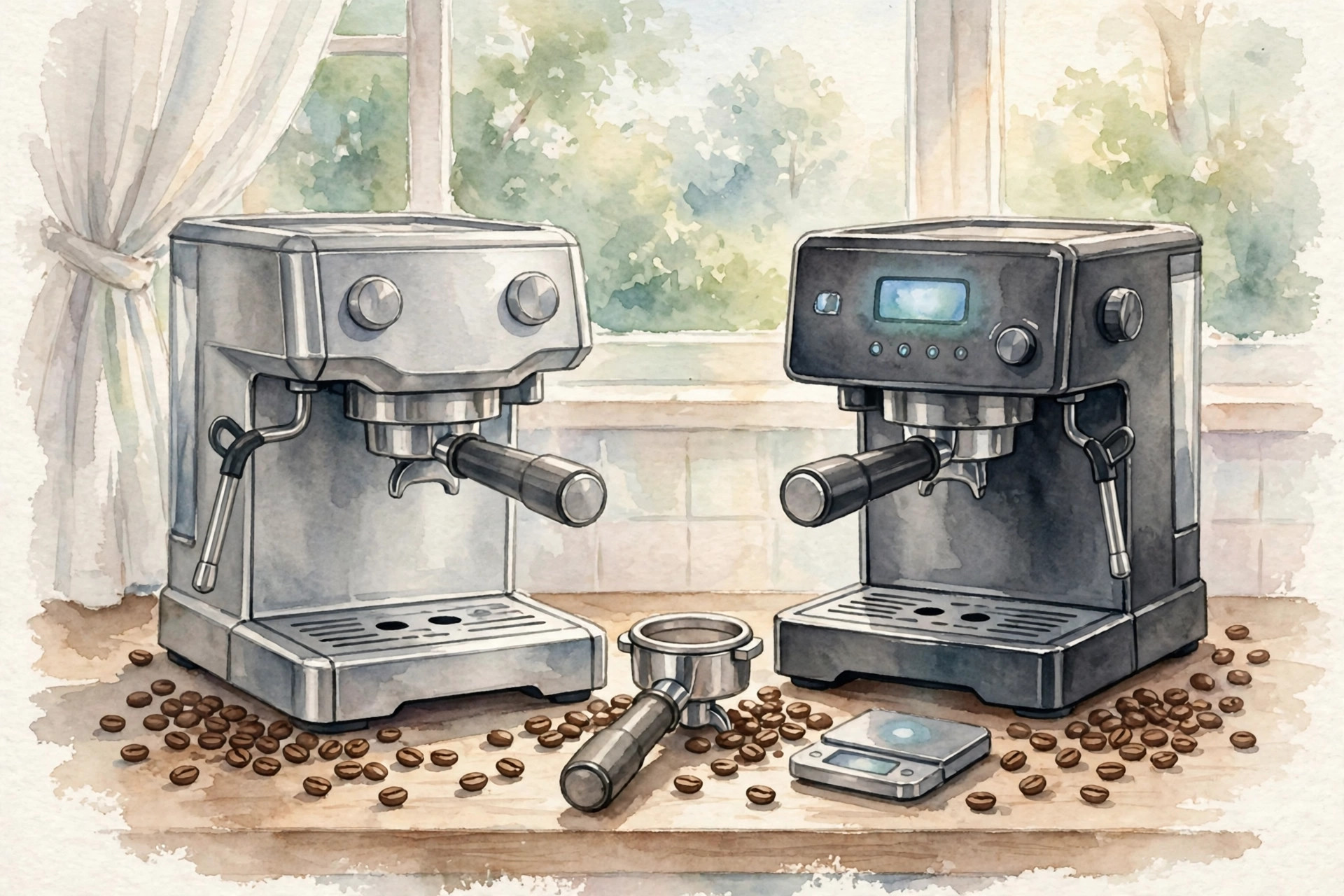
The first unboxing videos of the Sage Barista Express Neo landed on Instagram on 15 November — a stainless steel box, a portafilter, a shot pulled to 25 seconds, milk steamed, latte art poured. The machine goes on sale in the UK and Europe tomorrow, 17 November, at £779.95 (or €879.95 on the continent). No US price or date has been announced yet. And the timing is awkward in the best way: the machine the Neo replaces, the original Barista Express, is sitting at $499.95 in November sales in the US, down from its $699.95 list price. So the question this week is not which espresso machine to buy. It is what a home espresso machine $500 vs $1000 actually gets you — and whether the extra $500 is buying better coffee or just a smoother morning.
That is a real question with a checkable answer this week, because both tiers are fully stocked and fully priced. Here is the honest version of it.
/ 01The $500 tier is the real machine, not the compromise
Start with what $500 buys right now, because the answer is more than it was a year ago.
The Breville Barista Express (model BES870XL) is the benchmark of the tier, and it is the benchmark because it has been one for a decade: a conical burr grinder built into the machine, 16 grind settings, a 54 mm portafilter, a 15-bar Italian pump with PID temperature control, and a manual steam wand. You grind, you dose, you tamp, you pull the shot, you steam the milk. Nothing about that workflow is automated away, which is the point — it is a machine that teaches you espresso while it makes it. Its list price is $699.95, and in November 2026 it is selling at $499.95 across retailers, a manufacturer promotion that The Gadgeteer re-verified at that figure on 12 November.
It is not the only philosophy at $500. The Philips 2300 Series with LatteGo is listed at $499.99 against $699.99, and it is the opposite idea: a fully automatic machine that makes the drink at one touch, with a milk system that needs no steam wand technique at all. Same money, opposite idea about what a morning is for. The Breville teaches; the Philips removes the lesson. Then there is the De'Longhi Magnifica Start, an automatic with a milk frother, listed at $499.99 against $799.99. Three machines, one price, three different answers to the question of how much of the work you want to do yourself.
What $500 does not buy is precision. Sixteen grind settings sounds like plenty until you are chasing a shot that runs three seconds too fast and the next click takes you three seconds too slow. The original Express has no scale in the loop: you set the grind amount by hand, and if you want to know the dose you weigh it yourself. Heat-up takes its time, and the steam wand is entirely yours — good milk takes practice, and bad milk is entirely your fault. None of that makes the coffee bad. It makes the coffee yours, for better and worse.
/ 02The $1000 tier, and what the extra money is actually for
Double the budget and the machines stop asking you to compensate for them.
The Breville Barista Pro, at around $850, is the clearest example of what the step up buys. Same 54 mm portafilter, same built-in grinder, same footprint as the Express — but the heating system is ThermoJet instead of ThermoCoil, so it reaches temperature in seconds rather than minutes, and the grinder has 30 settings instead of 16, so each step is a smaller change and dialling in stops being a game of overshoot. That is the whole trade in one sentence: at $500 you are paying with patience, at $850 you are paying to skip the waiting.
The Ninja Luxe Café Pro, announced on 3 November in a Jonathan Adler collaboration and priced at $899.99, pushes the same idea further toward the automatic end. It keeps the integrated tamper system and precision temperature control of the Luxe Café line and wraps it in a designer finish — the point of the collaboration is the counter, not the cup, and the price says so. It is a machine for someone who wants café-quality espresso and a kitchen that looks considered, and who would rather not learn steaming technique to get there.
And then there is the Neo, which is the most interesting machine in this comparison precisely because it does not fit neatly into either tier. In the UK it costs £779.95 — more than a sale-price Express, less than a thousand dollars if it ever crosses the Atlantic at a comparable price, and nobody outside Sage knows what the US number will be yet. What it does, though, is change the argument about what the money is for.
/ 03Grind by weight is the Neo's real argument
The Neo's headline feature is Acaia Grind by Weight: the grinder weighs the coffee as it grinds, so every shot starts with the same dose. That sounds like a small thing until you have spent a month chasing a sour shot and wondering whether you changed the grind, the dose, or both. On the original Express, dose is a dial you set by hand and a scale you keep on the counter. On the Neo, dose is a number the machine holds constant, so when a shot tastes wrong, the grind is the only thing you changed. Thirty grind settings instead of sixteen means each change is smaller, too.
There is a second feature that will get more attention than it deserves: cold brew in under three minutes. It is a genuine trick — the machine makes cold coffee fast — and it is also a feature most buyers will use twice and forget. The grind-by-weight system is the one that changes every shot you pull. The cold brew button is the one that changes the launch video.
Sage is also talking about a feature called Smooth Shot, and the honest thing to say about it is that it is too new to judge. The Neo launched in November 2026; there are unboxing videos, not long-term reviews. Anyone telling you today how the Neo holds up after six months is guessing.
/ 04So which tier, for whom
This is where the comparison stops being about specifications and starts being about the person buying.
Buy the $500 tier if you are starting out and you are willing to learn in public, one shot at a time. The Barista Express at $499.95 is the best version of that deal — a real semi-automatic machine with a real grinder, at a price that has rarely been lower, and a machine with a decade of parts, forums, and secondhand demand behind it. If you would rather have the drink than the hobby, the Philips 2300 or the Magnifica Start at the same price will make it for you, and there is nothing wrong with that. The honest cost of the $500 tier is not money. It is the month of mediocre shots while you learn, and the scale you will eventually buy to fix the dose problem the Neo solves for you.
Buy the $1000 tier if you already know you drink espresso every morning and you are buying back time. The Barista Pro's ThermoJet heat-up and finer grinder steps are worth the money only if the three-minute wait and the coarse grind steps are things you actually notice, every day, and resent. The Ninja Luxe Café Pro is worth it if the design matters to you and you want the most automated version of this setup. And the Neo is worth waiting for if you are in the UK or Europe and the dose problem is the thing that has been annoying you — but if you are in the US, there is no price and no date yet, and waiting for a machine with no launch date is a way of not making coffee.
One more thing worth saying plainly: none of these machines makes bad beans taste good. A $500 machine with fresh, well-roasted beans and a $1000 machine with stale supermarket beans will settle the argument in the wrong direction, and the cheaper machine will win. Budget for beans before you budget for the second tier.
/ 05The prices, stated honestly
Every price in this piece is a reference price, checked on 16 November 2026, and every one of them can change: the Barista Express at $499.95 is a November promotion, the Neo's US price does not exist yet, and Black Friday week moves numbers by the hour. Check the current price before you buy, and compare against the machine's ordinary street price rather than its list price — a discount against a number nobody paid is not a discount.
The extra $500, in the end, buys three things: finer steps, faster heat, and a machine that holds one variable steady while you change another. That is worth it for a daily drinker who has already learned the basics. For everyone else, the $500 tier in November 2026 is the best deal home espresso has offered in years — and the machine at the centre of it has been proving that for a decade.
---
HexRoast is a coffee journal. No product is for sale and no preorder is open. Prices above are reference prices as listed on November 16, 2026, and change — re-check before repeating them. Contact: hello@hexroast.com.
Questions about this article: hello@hexroast.com — the one contact address for this site. HexRoast is currently a coffee journal; no product is for sale and no preorder is open.
/ 06Sources
- koffieTcacao News, November 2026 — Sage Barista Express Neo launch, Acaia grind-by-weight, 30 grind settings, cold brew under 3 minutes: https://koffietcacao.com/en/blog/koffietcacao-news-november-2026/
- OR Coffee Roasters, 9 November 2026 — Sage Barista Express vs Barista Express Neo comparison (16 vs 30 grind settings, Acaia Grind by Weight, £779.95 / €879.95, UK & Europe launch 17 November): https://www.orcoffee.info/blogs/blog/sage-barista-express-vs-barista-express-neo
- YouTube, 8 November 2026 — Barista Express Neo overview, UK £779.95 / EU €879.95, US price TBC: https://www.youtube.com/watch?v=NAxn9wd4p2M
- The Gadgeteer, 8 November 2026 (updated 12 November) — Breville Barista Express $499.95 vs $699.95: https://the-gadgeteer.com/2026/11/08/breville-barista-express-espresso-machine-drops-to-499-95-in-november-2026/
- CoffeeLabAdvisor — Barista Express vs Barista Pro comparison, Pro around $850, ThermoJet, 30 grind settings: https://www.coffeelabadvisor.com/compare/breville-barista-express-vs-barista-pro
- MarketMinute / BusinessWire, 3 November 2026 — Ninja Luxe Café Pro by Jonathan Adler, $899.99: https://www.marketminute.com/article/bizwire-2026-11-3-sharkninja-unveils-ninja-luxe-caf-pro-espresso-machine-by-jonathan-adler
- Instagram, 15 November 2026 — Barista Express Neo unboxing videos (@amsterdani, @joedoescoffee): https://www.instagram.com/reel/Dfxa4bHuCjc/ and https://www.instagram.com/reel/DfxL8tnNneV/
- Hexroast 15 November 2026 draft (Black Friday coffee gear deals) — Philips 2300 LatteGo $499.99 vs $699.99, De'Longhi Magnifica Start $499.99 vs $799.99, La Specialista Touch $599.95 vs $799.95 (prices as checked 15 November 2026).
- Rising Trends, November 2026 — coffee gear searches up 235% year over year; Breville Barista Express at 74,000 searches: https://www.risingtrends.co/trends/coffee-trends-2026
- Note: No affiliate links, no purchase links, no sponsored claims. All prices are reference prices that change; the Neo has no announced US price or launch date as of 16 November 2026. No first-hand testing is claimed — this is an editorial comparison based on published specifications, launch announcements, and verified sale prices.
More coffee writing in this section — no signup, no preorder, just the journal.
More in Build →