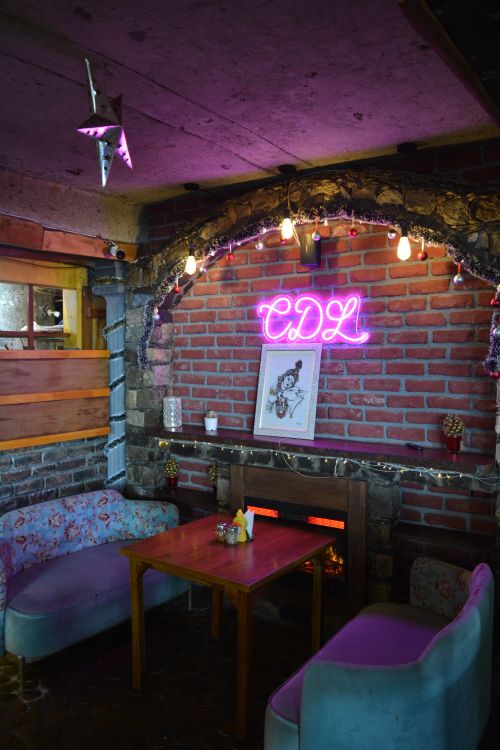
There is a specific kind of Tokyo café that none of the travel guides know how to describe. It is usually down a flight of stairs, or up three flights of them, behind a door that looks closed even when it is open. The lighting is warm and low. The music is slow. Somebody is brewing pour-over with the attention a watchmaker gives to a movement. And somewhere — on the wall, on the menu, in the typography of a sign — there is something that would not look out of place in the production design of Blade Runner.
We have spent three trips trying to figure out why. Here is a field report.
/ 01Glitch Coffee & Roasters — Jinbocho
The flagship room in the used-bookstore district, all concrete, black steel, and warm pendant lights. The coffee bar itself is stark enough to feel like a science experiment, but the brewing is unhurried. They publish their cupping notes the way a software team publishes changelogs. The name is on the nose, and earned.
What they got right: the absence of clutter. There is nothing on the counter except the bar equipment and the coffee. It turns out minimalism is a near-perfect aesthetic for cyberpunk; the future looks less like Blade Runner's neon-soaked chaos and more like Glitch's controlled emptiness.
/ 02About Life Coffee Brewers — Shibuya
Standing-only, about two meters wide, squeezed between a ramen shop and a pachinko parlor. You order at a window, wait thirty seconds, and are handed a cup that is unreasonably good. The whole interaction has the compressed efficiency of a well-designed API call.
About Life appears in more Instagram feeds of Western designers than probably any other Tokyo café. Not because of the coffee (which is legitimately great) but because of the storefront itself: a slice of warmth between two blocks of neon commerce, with the word "coffee" rendered in a font so restrained it feels loud.
/ 03Turret Coffee — Tsukiji
Built inside a former fish-auction turret, a space roughly the size of a food truck. The bar is a single slab of wood. The light is dim. The espresso is pulled on a machine that looks both older and more precise than anything in any North American café we have been in.
What makes Turret feel cyberpunk is not any futuristic element. It is that it is the kind of tiny, specialized, obsessively-maintained space that Gibson's protagonists were always trying to find. A place where someone who has spent thirty years on one craft is doing it for you at 8 AM, for about three dollars, and expecting nothing in return except that you appreciate the coffee.
/ 04Fuglen Tokyo — Shibuya
Norwegian-run, mid-century Scandinavian furniture, coffee in the morning and cocktails at night. Not Japanese in aesthetic at all, which makes its inclusion in this list sound wrong, but the venue's careful curation of other cultures' aesthetic languages is itself a very Tokyo move. Cyberpunk Tokyo was always a remix. Fuglen is a remix of a remix, and it lands.
The afternoon transition — baristas visibly switching modes from drip to cocktail, lights visibly dimming on a schedule — is one of the most cinematic hour-long sequences in the city.
/ 05Coffee Wrights — Kuramae
Three-story roastery in a quiet neighborhood that used to make leather goods. The ground floor smells permanently of green beans. The second floor is a slow reading room. The third is a roof that looks across the Sumida River at nothing in particular.
This is the one we keep recommending to developer friends visiting Tokyo. It is where to go when you want to work, not just look. The wifi is good. The tables are sturdy. Nobody will ask you to leave. You can write code here for four hours while drinking a sequence of increasingly thoughtful coffees, and no one will interrupt.
/ 06A theory of why Tokyo does this so well
Cyberpunk as a genre was always a Tokyo story told by Western writers. Gibson set Neuromancer's Chiba City here. Ridley Scott used Shinjuku as reference for Blade Runner. Masamune Shirow's Ghost in the Shell is Tokyo everywhere you look. The city was the source material long before the genre had a name.
What that means, we think, is this: you do not have to try to be cyberpunk in Tokyo. You have to try not to be. The density, the vertical commerce, the visible infrastructure, the way small specialized shops coexist with towers, the way neon reads against wet asphalt — all of it was already there. A café just has to be a good café, sited intelligently, and the aesthetic will find it.
It is a useful thing to remember when you are trying to build a brand or design a space anywhere else. You cannot fake this by adding neon. The best cyberpunk Tokyo cafés are the ones that did not set out to be cyberpunk. They set out to make one specific thing extraordinarily well, and the lighting did the rest.
/ 05What makes a space feel like this, in general terms
It is tempting to describe a cyberpunk café by its decorations, but the feeling usually comes from a combination of quieter choices. Lighting is the first. Low, warm pools of light over each table, with darker space between them, make a small room feel larger and more private than it is. Harsh, even overhead lighting does the opposite: it flattens everything into a waiting room. Materials are the second. Concrete, black steel, dark wood, and glass do not need to look expensive to feel coherent. They need to be used consistently, without a competing style fighting for attention in the same room.
Sound is the third, and it is often overlooked. A space that is meant for work needs a background level that masks conversation without demanding attention: low music, the sound of the espresso machine, the quiet clink of cups. Too silent, and every conversation feels exposed. Too loud, and concentration breaks. The cafés that get this right tend to treat sound as part of the design, not as an accident of whatever playlist happens to be playing.
Layout is the fourth. Small tables, clear sightlines to the bar, and seating that lets a solo visitor face outward rather than into a corner all signal that lingering is welcome. A bar counter where you can watch brewing happen turns waiting into part of the visit, rather than dead time before the coffee arrives. None of these choices requires a large space. In fact, they work best in small spaces, where every detail is close enough to notice.
For a home setup, the lesson is not to copy a specific room. It is to borrow the principles: one warm light source instead of three harsh ones, a consistent set of materials on your desk, a playlist at a level you can forget, and a brewing spot that is pleasant to stand at rather than a corner you hurry through. A coffee corner built on those principles will feel closer to the spaces described in this entry than any amount of neon signage would, and it will still be a place where actual work gets done.
More coffee writing in this section — no signup, no preorder, just the journal.
More in Culture →